Showing posts with label goldenrod. Show all posts

Sunday, October 24, 2010

Ambush Bugs


The sky was ominous this afternoon, but the temperature was a very pleasant 66-degrees.  Other than the usual suspects (chickadees, Purple Finches and nuthatches), there wasn't much avian activity along the Lower Chippewa River State Trail. 

So I decided to take a close look at the few goldenrods still in flower.  They were a-buzz with insects.  I felt some of them before I got close - female mosquitoes, getting in their last licks before the snow flies.  I spotted a few paper wasps, and a pair of what appeared to be copulating bugs with forelegs that reminded me of praying mantis.

Ambush Bugs paired
I've seen them before, but haven't been able to get a photo that could help me with identification.  Determined to get one today, I plucked the couple off the goldenrod and held them in my hand for good look (and better photo).

Was it a male was riding on the back of a larger (and lighter colored) female?  I'd have to figure it out when I got home. 

Ambush Bug
An hour later, I found them on Plate 3 in the Peterson Insects Guide: abdomen wider toward the rear; antenna 4 segmented, last segment swollen:  ambush bugs.

Known for sitting camouflaged on flowers (usually yellow or white), they wait to ambush their prey - the other insects working the flowers:  bees, wasps, flies, bugs and lepidoptera.  These tiny bugs are reported to take arthropods 10 times their size.

How to they do it?  They grab their prey with their modified forelegs and then bite, injecting a chemical that first paralyzes them, then liquefies their insides.  

Next time I see an ambush bug on a flower, I'll look for the lifeless exoskeletons of their prey nearby - on the flower and on the ground below.

Were they mating?  Maybe not.   Male ambush bugs are known for hitching a ride on the female's back as he waits to share in her hunting success.  (When ambush bugs mate, the male is lateroventral, not ventral-dorsal.)

If the pair I photographed today copulate, the female will glue her eggs onto a nearby twig, where they will over-winter and hatch out in May.  

Are they dangerous to handle?  While some references say they don't bite people, others say they do.   Next time, I won't take any chances.  I'll be carrying a glove in my pocket.

Saturday, October 9, 2010

Insects on Goldenrod Flowers

Megacyllene robiniae - Locust Borer

I've been looking at goldenrods lately - seeing insects I've never noticed before.

I have to admit I have a bias.  I'm willing to spend time looking at - and looking up - a butterfly or moth.  But for most of the other insects - I don't get much further than "wasp," "bee," or "beetle."

The name is the key to learning more about them.

My problem:   I just don't think I have the skill (or patience) to "key" them out.  

Today I decided to give it a try.  I started with the insects I photographed on goldenrod earlier this week.

First, the beetle (the Locust Borer in the photo above).  I pulled out a copy of the Peterson Field Guide (Beetles by White), leafed through it and found a black and white illustration (figure 123) that fit.  Then I googled it.  That success gave me the confidence to continue.

Heliothis zea - Corn Earworm Moth

I was pretty confident the next one (above) is a moth.  But after 15 minutes I wasn't so sure.  I couldn't find it in the dizzying array of moths in the Peterson Field Guide.  So I uploaded it to BugGuide.net.  Ten minutes later, I got an email with the ID.  Amazing!


It's a Corn Earworm moth, one of the nearly 3,000 North American species in the Noctuoidea superfamily.  The adult moth feeds on nectar and is associated with goldenrods in the fall.  Look for the green eye.   (If you've ever opened an ear of corn and found a "worm" - chances are you've seen the larvae of this moth.) 


Next was this wasp.  Which species?  I went to BugGuide again, and was surprised to discover it's one of the ~17 paper wasp species (Polistes) in North America.  This one's a male Northern Paper Wasp (the long antennae, square yellow face and blunt tip to the abdomen).

The Northern Paper Wasp "nest" is created by a dominent "gyne" (reproductive female) who builds an open-chambered nest and, without help, feeds the first batch of larvae.  When the first batch emerge, they stick around and help the dominent one raise the second brood.  In late summer, males hatch out.  They live a month or so and die when their job - fertilizing the recent hatch of females - is finished.   Fertilized females hibernate and start new colonies in the spring.

In the fall, these wasps feed on nectar.  In the summer, they feed on caterpillars and juices from ripe fruits. 

Entomologists are concerned that the introduction of the more aggressive European Paper Wasp (in the 1970s) has had an adverse impact on native Polistes.  Time will tell.

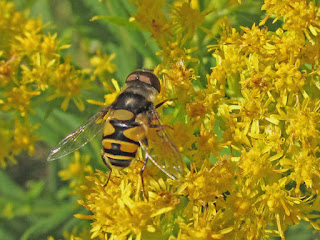
Eristalis transversa - Transverse Flower Fly

On to the last picture, a yellow and black insect.  I thought this one would be easy to identify.  It looks like a bee.  Buzzes like a bee.  Must be a bee.  Not!

I didn't find it in the Peterson Field Guide, so I up-linked this photo to BugGuide.  Minutes later, I got the ID.  It's a fly - a bee mimic known as the Transverse Flower Fly.   

There are 23 species of flower flies in North America.  Their larvae which are found in polluted water, are known as “rat-tailed maggots” a reference to the long breathing tube they extend to the surface of the water.   The adults are nectar-feeders.

If you spot one, take a close look at its head - it has hair on its eyes!


Tuesday, October 5, 2010

Black and Yellow Beetles on Goldenrod


While day time temperature has been in the 60s and 70s, overnight the temperature has dropped into the 30s.  Only a few wildflowers are in bloom along the Chippewa River State Trail - the asters, boneset and goldenrods.

I can't resist checking the goldenrods for soldier beetles.  I haven't found any lately.  But I have spotted a number of black and yellow insects with red legs and a big yellow "w" on their backs.  At first I thought they were hornets.

What are they (and what are they doing)?

Locust Borer Megacyllene robiniae

They are Locust Borers, named for their association with Black Locust trees.  In September and October the adults feed on goldenrod pollen.  Look for them in the morning.  In late afternoon you can spot them on the trunks of Black Locusts, looking for crevices in the bark on which they lay their eggs.

When the eggs hatch, the larvae chew their way into the inner bark and spend the winter in "hibernation cells."  In the spring, they bore deeper into the wood and feed.  They pupate inside the tree in July and August, and emerge as adults in the fall. 

The Black Locust, an invasive legume, is not native to Wisconsin.  It was originally planted here to control erosion, and for use as fence posts.  You can see it along the Chippewa River State Trail and Rustic Road 107.  I can't help but notice it's fragrant white flowers in the spring.

It's similar to the Hickory Borer, which is active as an adult in the spring.

Thursday, August 12, 2010

Goldenrod Soldier Beetles


Looking for a breeze and cooler temperatures, I hopped in the Prius and took a spin through the coulees east of the Lower Chippewa River.

Great Lobelia

I didn't find respite from the heat, but I did spot Great Lobelia, several species of goldenrod and a new (for me) insect on the flower of a Cup Plant Silphium perfoliatum, a very tall (6-8 ft), plant that looks like a sunflower, named for the water-catching cup created at the stems where the perfoliate leaves meet.  Look for American Goldfinches getting a drink of water from these cups.


Cup Plant flower
Cup Plant "cup"

I could identify the flower from a distance, but not the insects.

At first glance the copulating insects looked like fireflies.  When I got close enough to take a photo, I didn't see the luminous abdomens of lightning bugs.  I'd need a good photo and some time with the Peterson Field Guide to the Insects.

When I got home, I went to the insect guide and looked up lightning bugs.  My mystery insect was right there - on the same page, one beetle to the right:  a Goldenrod Soldier Beetle, Chauliognathus pennsylvanicus.

While I've never noticed them before, according to Extension entomologists they're common this time of year.

There are more than 1,000 species of Soldier Beetles world-wide, less than 200 in the US.  Also known as Pennsylvania Leatherwings, their soft wings are leather-like.  The name "soldiers" comes from their color patterns which resemble a military uniform.  Look for them on goldenrod flowers.

The adults are omnivorous, they feed on pollen, nectar, grasshopper eggs, maggots, small caterpillars and aphids. 

They overwinter as larvae.  Like Box Elder Bugs, they can be a nuisance when they end up in your basement looking for a place to over-winter.