Showing posts with label Moths. Show all posts

Wednesday, April 27, 2011

Lettered Sphinx Moth on the Window Screen

Lettered Sphinx Moth

I stopped by the Maxville Alternative School today to set up a date to take the students out to monitor bluebird boxes.

On the way back to my car,  Gwen Prom and I spotted this odd moth hanging on to the window screen near the light over the front door.  Its pumped-up shoulders reminded me of a scaled-down, brown-striped version of a TRANSFORMER (from the movie).

Lettered Sphinx Moth

Viewed from the side, the moth displays its abdomen arched over its back (scorpion-like).  I knew it was a moth, but what kind?  Other than "knowing" the big flashy species, my moth identification skills are woefully lacking.  So, with Gwen's help, I took three photos.

Lettered Sphinx Moth (with Gwen's Finger)

I emailed them to Marcie O'Connor, a local moth expert who lives on the other side of the coulees in southeastern Buffalo County.  She recognized our moth right away:  Lettered Sphinx

Armed with the name, I looked it up and found that while they are thought to be common, there are no photo records of this insect on www.bugguide.net for Wisconsin.

Lettered Sphinx, found in eastern North America, are one of the earliest to be out flying (and hanging on to window screens) in the spring.  Their green caterpillars feed on the leaves of grape and virginia creeper vines.

Mrs. Sweeney Points to the Lettered Sphinx

Sunday, October 17, 2010

A Black Moth Nectaring at Noon


I spotted this insect working a dried flower on the Lower Chippewa River State Trail today.  I thought it was a moth, but I wasn't certain.  I took a picture so I could look it up later.


It was another sunny day in October, but the temperature had dropped to around 50-degrees.  I thought it was too cold for butterflies until I spotted two Eastern Commas sunning themselves in the leaf litter.


Not many birds around mid-day, but I did see two Ruby-crowned Kinglets.  I heard a surprising number of chip notes coming from the shrubs along the trail... Fox Sparrows, juncos, cardinals and Chipping Sparrows.

I walked a mile then headed back home to figure out the name of my mystery black insect.


Compared to the insects I found last week, this one was easy to figure out:  a Yellow-collared Scape Moth - Cisseps fulvicollis.

A day-flying Tiger Moth that resembles a wasp, it's found nectaring on fall flowers, including goldenrods.    Adults appear in May and can be spotted into October until the first hard frost.

Saturday, October 9, 2010

Insects on Goldenrod Flowers

Megacyllene robiniae - Locust Borer

I've been looking at goldenrods lately - seeing insects I've never noticed before.

I have to admit I have a bias.  I'm willing to spend time looking at - and looking up - a butterfly or moth.  But for most of the other insects - I don't get much further than "wasp," "bee," or "beetle."

The name is the key to learning more about them.

My problem:   I just don't think I have the skill (or patience) to "key" them out.  

Today I decided to give it a try.  I started with the insects I photographed on goldenrod earlier this week.

First, the beetle (the Locust Borer in the photo above).  I pulled out a copy of the Peterson Field Guide (Beetles by White), leafed through it and found a black and white illustration (figure 123) that fit.  Then I googled it.  That success gave me the confidence to continue.

Heliothis zea - Corn Earworm Moth

I was pretty confident the next one (above) is a moth.  But after 15 minutes I wasn't so sure.  I couldn't find it in the dizzying array of moths in the Peterson Field Guide.  So I uploaded it to BugGuide.net.  Ten minutes later, I got an email with the ID.  Amazing!


It's a Corn Earworm moth, one of the nearly 3,000 North American species in the Noctuoidea superfamily.  The adult moth feeds on nectar and is associated with goldenrods in the fall.  Look for the green eye.   (If you've ever opened an ear of corn and found a "worm" - chances are you've seen the larvae of this moth.) 


Next was this wasp.  Which species?  I went to BugGuide again, and was surprised to discover it's one of the ~17 paper wasp species (Polistes) in North America.  This one's a male Northern Paper Wasp (the long antennae, square yellow face and blunt tip to the abdomen).

The Northern Paper Wasp "nest" is created by a dominent "gyne" (reproductive female) who builds an open-chambered nest and, without help, feeds the first batch of larvae.  When the first batch emerge, they stick around and help the dominent one raise the second brood.  In late summer, males hatch out.  They live a month or so and die when their job - fertilizing the recent hatch of females - is finished.   Fertilized females hibernate and start new colonies in the spring.

In the fall, these wasps feed on nectar.  In the summer, they feed on caterpillars and juices from ripe fruits. 

Entomologists are concerned that the introduction of the more aggressive European Paper Wasp (in the 1970s) has had an adverse impact on native Polistes.  Time will tell.

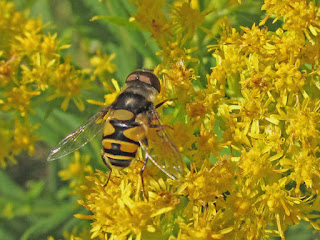
Eristalis transversa - Transverse Flower Fly

On to the last picture, a yellow and black insect.  I thought this one would be easy to identify.  It looks like a bee.  Buzzes like a bee.  Must be a bee.  Not!

I didn't find it in the Peterson Field Guide, so I up-linked this photo to BugGuide.  Minutes later, I got the ID.  It's a fly - a bee mimic known as the Transverse Flower Fly.   

There are 23 species of flower flies in North America.  Their larvae which are found in polluted water, are known as “rat-tailed maggots” a reference to the long breathing tube they extend to the surface of the water.   The adults are nectar-feeders.

If you spot one, take a close look at its head - it has hair on its eyes!


Saturday, June 12, 2010

My Mystery Cocoon : A Promethea Moth

I found a moth cocoon along the Chippewa River State Trail on March 15 and took it home to watch.

A moth emerged from the cocoon today...


Recognize it?  I wasn't sure, so I looked it up.

A female Promethea Moth.

The females of this species of giant silkworm moth are larger than the male, whose body is primarily black with two eye spots and light tan wing borders.

The adults live to breed - neither has mouth parts.  This female was ripe with eggs - ready to mate.


By the time I realized she'd hatched out of her cocoon, one male had battered himself trying to get to her (in a Reparium cage in which I put the cocoon) and another male was flying nearby.  The power of pheromones.

I snapped a photo and let them fly off to procreate.

Tuesday, April 27, 2010

Tent Caterpillars = Bird Food


Tent Caterpillars.  They seem to be everywhere these days, and that's got people talking.   I was talking with a friend about bluebirds yesterday, and she asked me - what can you do about those tent caterpillars?

I wasn't sure what she meant, so I asked.

The answer:  they're killing my trees.

It may look like they're killing your trees, but, really, they're not.


They eat leaves and it can look bad for the tree, but the leaves will, and do, grow back.  Watch and you'll see.  And if you leave them alone, the birds will eat them.  Tent caterpillars are bird food.  Why would you want to kill then when birds do it for free?

Are you sure?

Yes.  I Googled "tent caterpillars" back in March when I first noticed this egg mass on a cherry tree along the Chippewa River State Trail.

tent caterpillar egg mass

I discovered that these social caterpillars, while they may be "annoying" and "unsightly," are an important  food source for more than 60 species of birds, mammals (bears, mice and skunks) and frogs.

The bird predator list includes bluebirds, mockingbirds, orioles, chickadees, Blue Jays, warblers, Rose-breasted Grosbeaks, flycatchers and waxwings.

While cherry trees are the preferred hosts, tent caterpillars will feed on apples, peach, plum, birch, ash, willows, oaks and poplars.  The defoliated trees will grow new leaves in a just a few weeks.


Tent caterpillars overwinter as eggs and hatch out when the wild cherry buds start to swell open (this year in Wisconsin, it was early March).  I didn't witness the hatching, but entomologists say it takes a day or two.  Then the insects head to a crotch in the tree and spin their silken web - their first "tent." 
As they get bigger, they move to a larger fork in the tree and spin another, larger tent.  You can spot them in the tent when it rains, and during the heat of the day.  They leave the tent to feed on leaves at dawn, dusk and into the night.

It takes about 6 weeks before the caterpillars pupate.  Look for the white cocoons on the tree and in the vicinity of the tree.  The moths emerge in about 14 days.  They mate at night and the female lays her eggs in a day or two.  The male may live a week or so, but the females die after laying eggs.

Tent caterpillars are a spring phenomenon.  What you see in the late summer and early fall are "Fall Webworms," Hyphantria cuneaLike Tent Caterpillars, these animals appear during migration, providing food for birds.  They do not "kill" trees, they're more of an aesthetic "issue."

There's really no need to add poisons to your yard.  Lure birds to your yard with a water feature - and they'll do the job for you!

Saturday, April 17, 2010

A Day Flying "Mini Moth" - Grapevine Epimenis


I took a walk along a deer path this afternoon, dodging ticks to get yet another photograph of the Spring Beauty wildflowers carpeting the forest floor.

Grapevine Epimenis (Psychomorpha epimenis)

On my way back to the road, I spotted a tiny black butterfly with big spots - white on the forewing and red on the hindwing.

I spotted one yesterday too, but it was so very windy and the butterfly was so very tiny, I couldn't get a photo.  And now there it was, sitting on the road by my car door.  There I was, camera in hand. 

I snapped one photo and the flutterby, fluttered off.  Amazing how fast they can go.

I pulled out my field guide to butterflies.  This conspicuous creature wasn't in the book.   You'd think I would have thought - well, if it's not in the butterfly book, maybe it's a moth.  It never crossed my mind.

Stumped, I sent the image to WisconsinButterflies.org - and I uplinked it to bugguide.net.  Turns out it was a moth not a butterfly.  It was so small, I couldn't see the antennae, or I'd have looked at the moth book.

Armed with a name, I discovered on butterfliesandmoths.org that this woodland day-flier is often mistaken for a butterfly.  The adult Grapevine Epimenis moth feeds on the nectar of plums and cherries.  From late April to June, the orange-headed black and white caterpillar feeds from a rolled up leaf "tents" on summer, fox, riverbank and frost grape vines.


Grapevine Epimenis (Psychomorpha epimenis)

Wednesday, December 2, 2009

Cocoon

More on this - when I figure out which moth it belongs to

Friday, November 6, 2009

A Tiny Moth on an Unseasonably Warm Day


I spotted a very small (about an inch long) whitish insect - a flitting along the Chippewa River State Trail today.   A butterfly, or moth?

Every time it stopped, I would hurry over with my little Sony CyberShot, bend down, and ...  off it would fly again.  I was about ready to give up, when it flew down and landed on a plant.

If I could take a photo, I might be able to figure out what it is.  I snapped one photo, and off it flew.  In the camera, it looked much darker - but maybe good enough for an identification.

After I got home and downloaded it, I went to my favorite web page, The Bug Guide.  I thought I had it figured out - a dogbane saucroboyts, but I wasn't quite sure.  So I sent an email off to Phil Pelliteri at the University of Wisconsin.  He suggested a late season inchworm, a geometrid.

I went back to the bug guide, and uploaded my photo.  Charlie Eiseman responded with Bruce Spanworm.  Looks right to me.

The caterpillars of this species feed on the leaves of hardwood trees.  Sugar Maples and Aspens are among their favorites.  By the end of June they pupate on the ground and emerge as adults in October or November.  The wingless females lay their pale green eggs singly, in the crevices of tree bark.

Wednesday, October 7, 2009

A Three Caterpillar Day


The familiar woolly bear caterpillars were out and about today, crossing highways and walkways (squish) looking for safe places to hibernate.  Call me crazy, but I actually try to dodge them when I'm driving.

I assume their orange coloring and hairs are a message to predators that they are distasteful.
According to meteorology myth, the coloring on these creatures suggest the severity of winter - the larger the lighter band, the less severe the winter will be.  The abundance of the orange band is an indication of the age of the caterpillar rather than seasonal prognostications.

If you try to handle one, expect it to assume the defensive posture:  it will curl up into a ball.

While I'm not bothered by the bristly hairs, they have caused allergic reactions in some people.  If you start to itch, gently put it down.

The larvae of the creamy-colored Isabella Tiger Moths (Pyrrharctia isabella) feed on greens along roadsides - plantain, dandelions and grasses.  They over-winter as caterpillars, then pupate into a hairy cocoon in early spring.

If you find one and want to try to over-winter it, click here for information.

This Pale Tussock Moth, also known as Banded Tussock Moth, (Halysidota tessellaris) caterpillar was crawling up an elm tree at Buena Vista Park in Alma, Wisconsin.

While there is a wide range in the color of this caterpillar's bristles, the black head and elongated black and white hair "pencils" on the head and rear are diagnostic.  Look for a dark black stripe down the center of the back.

The larvae feed on several trees, including ash, birch, hickory, oak, poplar, tulip tree, walnut and willow.

The Pale Tussock Moth caterpillar reminded me of a caterpillar  I spotted several in September at Pictograph Cave State Park in Billings, MT, an American Dagger Moth.  This one was feeding on a huge Box Elder tree near the parking lot. 
This colorful, but hairless Zebra Caterpillar crossed my path later in the day, along the Chippewa River State Trail.  It's the larval form of the Zebra Caterpillar Moth.

I assume it was feeding on the alfalfa in the field along the trail.

The larvae also feed on cabbage, carrot, clover, dandelion, dock , pea, pigweed  strawberry, sweetfern, blackberry, blueberry, hazel, apple, birch, cherry, plum and willow.