Showing posts with label beetles. Show all posts

Tuesday, October 19, 2010

Why did the Dung Beetle Cross the Trail?

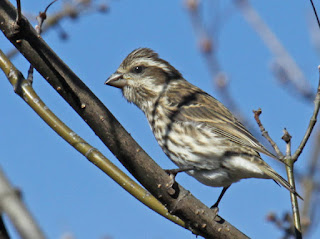
female Purple Finch
When I walk the Chippewa River State Trail, I'm usually looking up - for birds. 

Today the familiar crunch, crunch of my shoes crushing the hackberry nipple galls attached to the now fallen yellow and brown leaves, made me look down.

Hackberry Nipple Galls


That's when I noticed this quarter-sized irridescent beetle scurrying across the trail, disappearing in the leaf litter.


I'm not afraid of beetles, but this one looked like a mini tank, and I wondered about those reddish-orange comb-like antennae.  It was moving too fast for me to photograph it on the ground, so I threw caution to the wind and picked it up.

I've never taken an entomology course, so I was clueless about how to hold one of these creatures safely (for it and me).  As I was working on getting my camera readied - and holding the beetle in the palm of my hand, it flipped upside-down.

phoretic mites on an earth boring beetle
That's when I noticed a dozen or so little transparent creatures clinging to the beetle's chest.  Hm.  What are they?

They weren't eggs.  They were moving round on that chest.
They weren't "baby" beetles.  Beetles go through complete metamorposis from egg to larvae to pupae to adult.
I found the answer later when I uplinked my photos at www.bugguide.com.

They're phoretic mites.  Phoresy is the term used to describe the relationship between two species where one attaches to the other for transportation.   Harmless to the beetle (and me), these arthropods feed on the eggs of the flies attracted to the same food that the beetle eats.  They hitch-hike on beetles to get from meal to meal.

This beetle, one of more than 600 species world-wide in the Geotrupe family, is one of the earth boring beetles.   Male Geotrupes are are known for dragging decaying and moldy leaf litter, fungi and occasionally dung, into their tunnels.  Then they wait for the females to show up.  After copulation, the female lays her eggs on the food the male has provisioned.

So, what was this beetle doing crossing the trail?

Maybe it was checking out the leaf litter or heading to its next meal.

Tuesday, October 5, 2010

Black and Yellow Beetles on Goldenrod


While day time temperature has been in the 60s and 70s, overnight the temperature has dropped into the 30s.  Only a few wildflowers are in bloom along the Chippewa River State Trail - the asters, boneset and goldenrods.

I can't resist checking the goldenrods for soldier beetles.  I haven't found any lately.  But I have spotted a number of black and yellow insects with red legs and a big yellow "w" on their backs.  At first I thought they were hornets.

What are they (and what are they doing)?

Locust Borer Megacyllene robiniae

They are Locust Borers, named for their association with Black Locust trees.  In September and October the adults feed on goldenrod pollen.  Look for them in the morning.  In late afternoon you can spot them on the trunks of Black Locusts, looking for crevices in the bark on which they lay their eggs.

When the eggs hatch, the larvae chew their way into the inner bark and spend the winter in "hibernation cells."  In the spring, they bore deeper into the wood and feed.  They pupate inside the tree in July and August, and emerge as adults in the fall. 

The Black Locust, an invasive legume, is not native to Wisconsin.  It was originally planted here to control erosion, and for use as fence posts.  You can see it along the Chippewa River State Trail and Rustic Road 107.  I can't help but notice it's fragrant white flowers in the spring.

It's similar to the Hickory Borer, which is active as an adult in the spring.

Thursday, August 12, 2010

Goldenrod Soldier Beetles


Looking for a breeze and cooler temperatures, I hopped in the Prius and took a spin through the coulees east of the Lower Chippewa River.

Great Lobelia

I didn't find respite from the heat, but I did spot Great Lobelia, several species of goldenrod and a new (for me) insect on the flower of a Cup Plant Silphium perfoliatum, a very tall (6-8 ft), plant that looks like a sunflower, named for the water-catching cup created at the stems where the perfoliate leaves meet.  Look for American Goldfinches getting a drink of water from these cups.


Cup Plant flower
Cup Plant "cup"

I could identify the flower from a distance, but not the insects.

At first glance the copulating insects looked like fireflies.  When I got close enough to take a photo, I didn't see the luminous abdomens of lightning bugs.  I'd need a good photo and some time with the Peterson Field Guide to the Insects.

When I got home, I went to the insect guide and looked up lightning bugs.  My mystery insect was right there - on the same page, one beetle to the right:  a Goldenrod Soldier Beetle, Chauliognathus pennsylvanicus.

While I've never noticed them before, according to Extension entomologists they're common this time of year.

There are more than 1,000 species of Soldier Beetles world-wide, less than 200 in the US.  Also known as Pennsylvania Leatherwings, their soft wings are leather-like.  The name "soldiers" comes from their color patterns which resemble a military uniform.  Look for them on goldenrod flowers.

The adults are omnivorous, they feed on pollen, nectar, grasshopper eggs, maggots, small caterpillars and aphids. 

They overwinter as larvae.  Like Box Elder Bugs, they can be a nuisance when they end up in your basement looking for a place to over-winter.

Wednesday, August 4, 2010

A Dung Beetle (Rainbow Scarab)


I pulled into the DNR parking lot along County Road M just outside of Durand around noon today.   I wanted to get a closer look at the butterflies I spotted at the edge of the prairie.  A Red Admiral, Clouded Sulphurs and a Gray Comma.

Hackberry Emperor on dung
I spotted another dark butterfly near the north edge of the parking lot.  I got out of the Prius to take a closer look.  It was a fresh new Hackberry Emperor. I haven't seen any Emperors in several weeks, so I was surprised to spot this one sitting on what looked like a pile of raccoon scat (full of undigested field corn and red berries).

As I took the photo, a clump of scat started to move.  

At first I thought it was one of those "candid camera" tricks.  You know - there's an invisible string. Someone starts to pull on it.  It's supposed to startle me.

It worked.  I was startled.  But I was also curious.  There's no string, so what's making the dung move?

Rainbow Scarab Beetle pushing dung

I stood still and watched as a relatively large iridescent green, red and blue beetle with yellow antennae appeared out from under the clump of dung.  The first thought that popped into my mind was:  dung beetle!

In all the years I've walked in the woods, I'd never seen one before.  When I got back home, I did a search and discovered it's a Phanaeus vindex - a Rainbow Scarab Beetle.  The males of this species have a big black horn.  This one was hornless - a female, apparently working alone.

These harmless beetles usually work in pairs.  The male and female excavate holes under the dung pile and push the dung into them.  The female then lays her eggs in the excrement which provides nourishment for her offspring.

I was awed by the Herculean effort she put in to moving that dung.

She had to move it because the inconsiderate raccoon left it on top of the tightly compacted 
parking lot.  There's no way she could dig down under it.  Her only recourse was to push that dung over to the prairie on the south side of the parking lot.  

It took her 30 minutes to get the job done.