Showing posts with label Wasps. Show all posts

Sunday, October 10, 2010

An Ichneumon Wasp


I don't know what surprised me more today - the unseasonable string of warm days, the wildflowers still in bloom along rural roads in west-central Wisconsin coulees or spotting this black insect on a late flowering Queen Anne's Lace.

I photographed it because I thought it would be easy to identify - the white on the back, tail and antennae.

I was wrong.  I looked through the insect field guide.  I couldn't find it. 

I had to resort to BugGuide.net again.  And again, I got a quick response:  a male Vulgichneumon brevicinctor, one of the most common of the 5,000 or more species of ichneumon wasps in North America.  There may be as many as 100,000 species world-wide, making it the largest of animal families.

Once I got a name, I recalled that I actually had read something about them some time ago.

I'd read that they're not like other wasps.

They're not social.   The females have long ovipositors and use them to lay their eggs in caterpillars.  When the eggs hatch, the larvae of these wasps are parasites.  They convert their hosts into their own personal food factories.

Here's what I found out today:  Ichneumons are species-specific in their choice of hosts.  The female ichneumon uses her antennae to locate a host for her eggs.   (The word ichneumon comes from the Greek word for hunter.)

Because many of their hosts are agricultural pests (caterpillars and beetles) they are considered to be "beneficial" insects.   Some species of ichneumons however, parasitize harmless spiders and other wasps.  One specializes in the aquatic larvae of the caddisfly.  Another pierces wood to reach its host.

When the ichneumon eggs hatch, the larvae feed on the body of the host, keeping the host alive just long enough for them to pupate and for the adult wasp to eat its way out.  (Inspiration for the sci-fi horror film Alien).

The gruesome life cycle of the ichneumon wasp has troubled many naturalists and theologians, including Charles Darwin.   In 1860, Darwin wrote about it in a letter to Asa Gray:


There seems to me too much misery in the world. I cannot persuade myself that a beneficent and omnipotent God would have designedly created the Ichneumonidae with the express intention of their feeding within the living bodies of Caterpillars, or that a cat should play with mice.

You can read more about this in an essay on Nonmoral Nature by Stephen Jay Gould.

By the way, the feeding behavior of adult ichneumon wasps is less disturbing.   They feed on water and flower nectar.

Saturday, October 9, 2010

Insects on Goldenrod Flowers

Megacyllene robiniae - Locust Borer

I've been looking at goldenrods lately - seeing insects I've never noticed before.

I have to admit I have a bias.  I'm willing to spend time looking at - and looking up - a butterfly or moth.  But for most of the other insects - I don't get much further than "wasp," "bee," or "beetle."

The name is the key to learning more about them.

My problem:   I just don't think I have the skill (or patience) to "key" them out.  

Today I decided to give it a try.  I started with the insects I photographed on goldenrod earlier this week.

First, the beetle (the Locust Borer in the photo above).  I pulled out a copy of the Peterson Field Guide (Beetles by White), leafed through it and found a black and white illustration (figure 123) that fit.  Then I googled it.  That success gave me the confidence to continue.

Heliothis zea - Corn Earworm Moth

I was pretty confident the next one (above) is a moth.  But after 15 minutes I wasn't so sure.  I couldn't find it in the dizzying array of moths in the Peterson Field Guide.  So I uploaded it to BugGuide.net.  Ten minutes later, I got an email with the ID.  Amazing!


It's a Corn Earworm moth, one of the nearly 3,000 North American species in the Noctuoidea superfamily.  The adult moth feeds on nectar and is associated with goldenrods in the fall.  Look for the green eye.   (If you've ever opened an ear of corn and found a "worm" - chances are you've seen the larvae of this moth.) 


Next was this wasp.  Which species?  I went to BugGuide again, and was surprised to discover it's one of the ~17 paper wasp species (Polistes) in North America.  This one's a male Northern Paper Wasp (the long antennae, square yellow face and blunt tip to the abdomen).

The Northern Paper Wasp "nest" is created by a dominent "gyne" (reproductive female) who builds an open-chambered nest and, without help, feeds the first batch of larvae.  When the first batch emerge, they stick around and help the dominent one raise the second brood.  In late summer, males hatch out.  They live a month or so and die when their job - fertilizing the recent hatch of females - is finished.   Fertilized females hibernate and start new colonies in the spring.

In the fall, these wasps feed on nectar.  In the summer, they feed on caterpillars and juices from ripe fruits. 

Entomologists are concerned that the introduction of the more aggressive European Paper Wasp (in the 1970s) has had an adverse impact on native Polistes.  Time will tell.

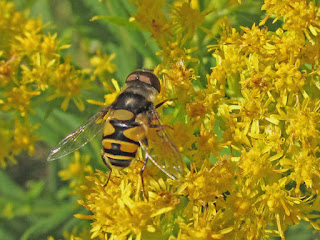
Eristalis transversa - Transverse Flower Fly

On to the last picture, a yellow and black insect.  I thought this one would be easy to identify.  It looks like a bee.  Buzzes like a bee.  Must be a bee.  Not!

I didn't find it in the Peterson Field Guide, so I up-linked this photo to BugGuide.  Minutes later, I got the ID.  It's a fly - a bee mimic known as the Transverse Flower Fly.   

There are 23 species of flower flies in North America.  Their larvae which are found in polluted water, are known as “rat-tailed maggots” a reference to the long breathing tube they extend to the surface of the water.   The adults are nectar-feeders.

If you spot one, take a close look at its head - it has hair on its eyes!


Thursday, December 17, 2009

The Wasp's Pot


We were on the road to the wetlands atop Ruffner Mountain in Birmingham, Alabama this afternoon, when Peter Van Zandt pointed out a tiny mud pot attached to the stem of a dried plant.

Who "threw" this pot?

My first thought:  maybe a relative of the mud dauber wasp.

It wasn't until I got home and searched bugguide.net that I found similar images.   This pot was constructed by one of the 8 species of "Potter" wasps in the genus Eumenes, relatives of the Yellowjacket, Paper Wasp and Hornet.

The most common species in the east is Eumenes fraternus.  Take a look at this webpage to see photos of what goes on inside inside the pot.

The female of these solitary wasps constructs the pots, one at a time, by mixing mud and hair.  She'll often construct several of them, along a branch or stem.

Then she "provisions" them.   She captures, anesthetizes and stuffs a couple of small caterpillars, usually cankerworms or sawfly larvae, into the pot.  Then she lays a single egg in her pot and seals it with a mud plug.   When the egg hatches, the larvae feed on the "provisions."  The adult wasp escapes by chewing its way out through the mud wall.

There are two generations of this wasp each year - late spring to early fall.  They over-winter in the pot and emerge as adults in the spring.

I've noticed wasps at my hummingbird feeders in the fall.  Next year, I will pay closer attention.   How many eggs does she lay?  How long does it take her to "throw" a pot?