Showing posts with label birds. Show all posts

Friday, May 6, 2011

Bobolinks!

Bobolink in Durand, Wisconsin

After spending the past couple of days looking at migrants on the Buffalo River in Alma, I decided to check out the Lower Chippewa River bottoms this morning.  I stopped along County Road M several times - teased by Yellow-rumped Warblers flitting from the road to the brush and into the grass.  

I wasn't a mile from State Road 85 when I heard what I thought was the sound of the avian version of a calliope.

But it couldn't be Bobolinks.  Not here in Durand.

I've only seen them twice:  years ago in a farm field along the Delaware River in northern New Jersey, and more recently at Crex Meadows in northwestern Wisconsin.  Both times I made a special trip just to see these rare grassland blackbirds.

I've driven County M for years and I've never seen or heard Bobolinks there.

No, it couldn't have been Bobolinks.  But what was that sound?

I slowly eased my stealth Prius back on to County Road M - and scanned the unremarkable, as yet un-plowed, farm field.  Then I heard it again.  I pulled off the road on to the shoulder and again looked for the sound.  There they were:  three Bobolinks!
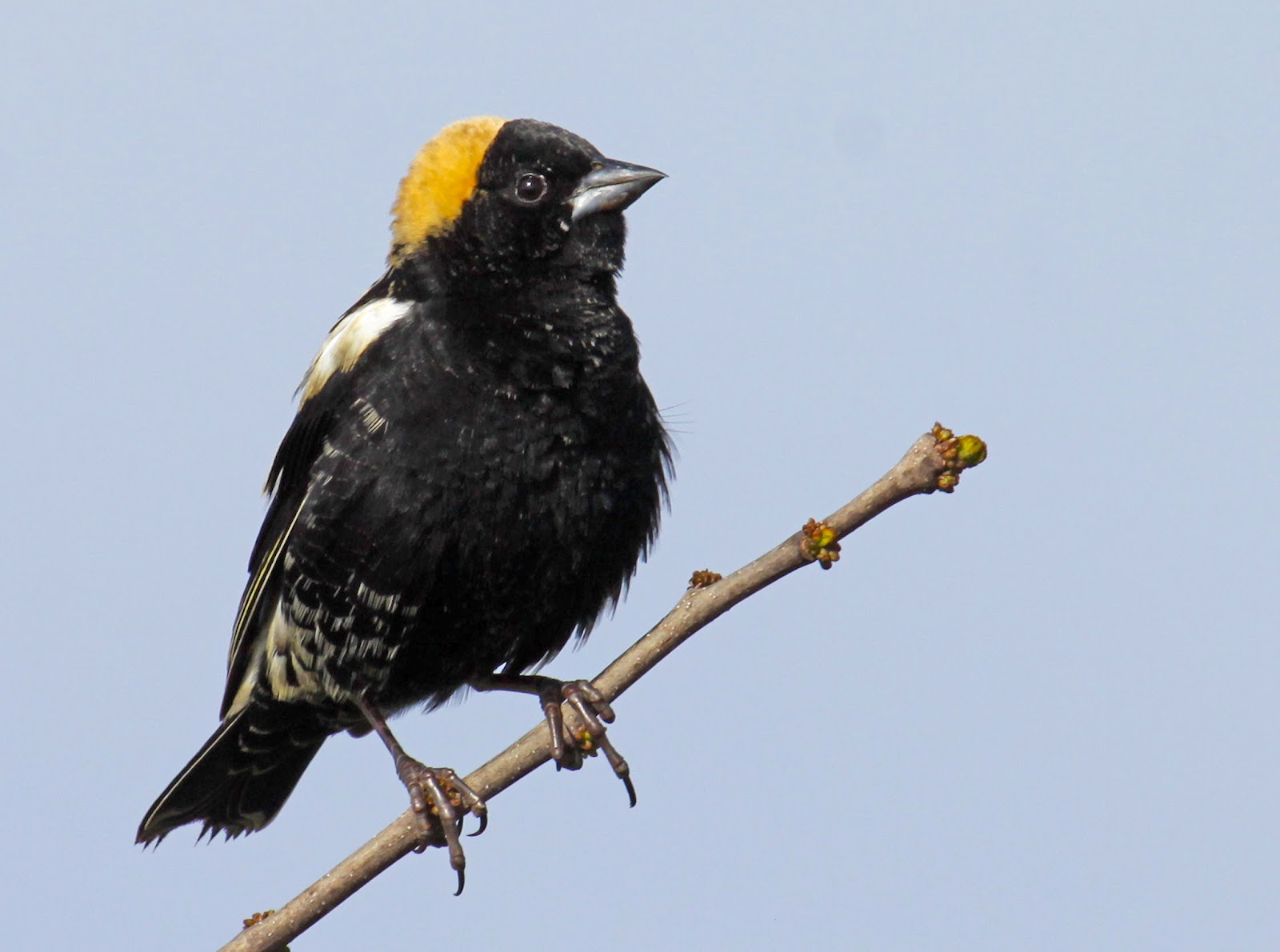
Bobolink

Tom and I sat and watched the trio for almost an hour.  They flew laps around the field, stopping to forage in the growing hay.  Then they were up again, flying in a circle, landing atop the shrubs along the side of County Road M, looking at us.

Bobolink
Bobolink
Bobolink

Bobolink

According to the Wisconsin Bird Conservation Initiative, Bobolink populations in the Badger State are declining at a precipitous rate - approximately 2% a year since the mid-1960s.  Why?  Loss of prairie habitat, modern agricultural practices (mowing alfalfa and hay fields during the breeding season), and, on their wintering grounds in the grasslands of South America (where they're considered agricultural pests) they're shot or sold as cage birds. 

It was great to see and hear them, but I hope these three don't stay in this field.   They're likely to do better in the prairies along the Lower Chippewa.

Wednesday, February 9, 2011

How Do Birds Keep Their Feet From Freezing?

Wild Turkey in Arkansaw, Wisconsin
Today's high temperature was 9º F with an overnight low of -8.  The sun was out - so it didn't feel so cold - inside my Prius.  Outside was another story altogether.

The chickadees at my feeders were all puffed out.  Their little bodies were almost as wide as they were long.   The eagles were perched in their usual trees back in the coulees, soaking up the rays.  But there weren't many birds along the roadsides, even though the snow plows had been by to clear the shoulders of the road - exposing grit and weed seeds.

The windchill advisory warned of temps in the double digits below zero.


We headed out to Arkansaw, Wisconsin.  I wanted to see how liverworts deal with winter.  I'd staked out a roadside colony of these primitive plants last fall.  We found them and I was surprised to see that they stay alive - and green - over the winter.


Mosses & Liverworts (green) and Ferns (brown)

On the way back to town, a Wild Turkey trotted out of the woods in front of the Prius.   I stopped the car, rolled down my window (the blast of cold nearly took my breath away) and pointed my camera at the hen.

She trotted off into the snow - sinking up to her feathered tibiotarsus.  I expected her to fly, but she pulled herself out of the deep snow and walked up on the crust.  Brrr...


Even in my insulated boots, I have trouble keeping my feet warm.  So how do birds keep their naked feet from freezing?

It's all about controlling heat loss in their feet.

Avian feet are comprised primarily of tendons, ligaments and bone - and not much muscle, nerves and blood.  They don't need to keep their feet as warm as we do.  Just above freezing will do.

   -  Their feet are covered with scales which are less susceptible to freezing.

   -  The circulatory system in avian feet - the proximity of their veins and arteries - creates a biological "countercurrent" heat exchange.  Waterfowl have a more complex net of arteries and veins - a "rete mirabile" - that helps keep the temperature in their feet just above freezing.

    -  Birds can constrict the muscles in their legs to actually pump warmer arterial blood into their feet.

And when that's not enough, birds can stand on one foot.  That way they can heat up their cold feet in warm downy feathers - one foot at a time.

Thursday, September 2, 2010

Nighthawk Migration


I was watching the news on TV when an old red pickup truck pulled into our driveway and parked by the pole barn this evening around 6:45pm.  I didn't recognize the truck or the driver, so I got up and went outside to see who it was.  It was  Paula - a prairie farmer from down the road in the village of Pepin - the birthplace of Laura Ingalls Wilder.  She'd just gotten her pickup fixed (leaky gas tank) and she was driving by, so she stopped to say hi.

Had she not pulled in to my driveway, I'd have never seen the sky darkening with birds.  First a dozen or so, then literally hundreds swirled over my house.  Paula had no idea what I was looking at.


I tapped on the kitchen window and yelled at Tom: grab my camera and come on outside - the sky is full of nighthawks!  I'd seen recent reports on the birding list-servs, but I didn't expect to see such a congregation in my yard.   Nighthawks migrate in flocks (sometimes in the hundreds) through the Upper Midwest on their way to their wintering grounds in Cuba and South America.

Common Nighthawk - Breeding Bird Survey - ©USGS         

Together the three of us stood in awe, heads tilted back, eyes to the sky as we watched these birds silently attack a swarm of insects about 400-feet above us.   We watched until the mosquitoes (down here at ground level) became intolerable.

Ironically, nighthawks are known for eating flying insects - flying ants, grasshoppers, dragonflies, moths and mosquitoes (thus their common name:  "mosquito hawk").  They're active at dawn and dusk, and sometimes during the day when the sky is gray.

It doesn't matter where you live - you can see them where ever there's night-flying insect prey.   In cities, watch for them around baseball fields where night lights attract insects. 

These Blue Jay-sized birds nest on the ground, but the flat roofs of urban buildings also make great nesting sites for them.  


Watch for the erratic, bat-like flight (the origin of their other common name "bull bat."  The word "bull" is a reference to the noise their wings make during their amazing aerial breeding displays). 

Listen for their call - a nasal "pee- enttt."

These amazing birds are in the order Caprimulgiformes, commonly known as "goatsuckers" -  a name created by ancient herdsmen who, seeing these birds flying around their goats at dawn, blamed them for low milk production.

The frogmouth of Australia and Asia, and the Oilbird, potoos, and nightjars (Whippoorwill and Pauraque) of the new world are members of this order.


Wednesday, August 25, 2010

Abnormal Bluebird Eggs


When I took this photo a few weeks ago, I didn't notice anything out of the ordinary.  I was happy to see 5 Eastern Bluebird eggs in a nest box that had not been productive this season. 

I didn't take them out of the nest box for a close inspection.


Next time I looked, 3 had hatched.   If the other 2 eggs were going to hatch, it would happen soon.

Two days later,  I went back to check on them.  The chicks looked good, but the eggs were cold.   That's when I took them out for a closer look.


"normal" bluebird egg and 2 "runt" eggs
While I'd never seen one before, I knew right away one of the eggs was a "runt."  It was round and about half the size of a normal bluebird egg.  I didn't realize the other egg was abnormally small (by 25%) until I compared it with a "normal" bluebird egg.  Both had tiny yellow yolks - but no sign of an embryo.

What causes dwarfed eggs?

Scientists don't know for sure.

But "runt" eggs are not as unusual as I thought.  The Western Foundation of Vertebrate Zoology has more than 1,000 in their collection.  And "runt" eggs have been found in most all species - not just bluebirds.

While they may not "know" much about them, scientists have correlated the occurrence of "runts" with the age of the female (younger birds are more likely to lay them) and a temporary impairment of the reproductive tract.

They don't believe it's an inherited trait, despite the 1983 report by my old friend Larry Zeleny (founder of the North American Bluebird Society).  Larry observed a banded hen in that laid 4 runt eggs in 3 separate clutches in one season.

Next time I find an abnormal egg, I'll contact the NABS to find out who might want to study it.

Wednesday, August 18, 2010

Eastern Bluebird Egg Color


Earlier this season a neighbor up the road near Durand called to tell me about the 3 white eggs in one of her bluebird nest boxes.

Bluebird eggs are usually blue.  Tree Swallow eggs are white.

I asked:  Could they be Tree Swallow eggs?

Tree Swallow Nest

No, she said.  It's a bluebird nest.  There are no feathers lining the nest.  I've seen bluebirds going in and out of the box.

White bluebird eggs are unusual, but not unheard of.   Curious, I went over to take a look.

White Eastern Bluebird Eggs

No doubt about it.  She had white bluebird eggs.

As it turned out, this would be the first of 4 nests with white eggs this season.

That got me thinking.

Why are bluebird eggs blue?  Don't most cavity nesting birds - songbirds, Belted Kingfishers and Wood Ducks - lay white eggs?  How do bird color their eggs?

Beyond genetics, some the explanations for egg color seem obvious.

Speckled eggs makes sense for Killdeer, who nest on the ground, or Yellow Warblers who lay their eggs in open nests.  It’s more difficult for predators to spot eggs that blend in with their surroundings.   


But why would cavity nesting House Wrens, who also lay speckled eggs, need to camouflage them?

Scientists at Oxford University recently suggested a completely different explanation for speckled eggs.   They hypothesized that the speckles might increase shell strength, compensating for thinner egg shells caused by calcium deficiencies in their diet. 

The scientists looked at eggs of the Great Tit (Parus major) and found that eggs with the thinnest shells had the most speckling.  And the thinner the shell, the darker the spots.  They concluded that chemicals in the speckle pigment may work like glue, supporting weak areas of shell, protecting them from breaking.  

But what about those plain white eggs?   

There seem to be obvious advantages:  in the low light of tree cavities and tunnels, white eggs should be easier to spot; and it takes less energy to lay a plain white egg.   

The “less energy” hypothesis has to do with anatomy and biochemistry of the hen’s oviduct.   It’s complicated, but here’s the simpliflied version.  As eggs are laid, glands along the hen’s oviduct deposit pigments on top of the basic white shell, comprised primarily of calcium carbonate - a mineral found in chalk, limestone and marble. 

The amount of pigment and the timing of pigment release determine the base color of the egg and its distinctive markings (the speckle pattern).   As the egg enters the oviduct, the first pigment released creates the base color of the egg.   Blue and green are created by pigments known as the biliverdin and the zinc chelates.
  
According to the North American Bluebird Society, in 5-9% of reported nest observations, bluebirds laid clutches in which the eggs were a uniform, lighter color – white, pale pink or pale blue.  

It was once believed that laying white eggs was a genetic trait – like blue eyes and brown eyes in humans.  Bluebird hens that lay white eggs, will always lay white eggs.

But now there's a new theory about egg color in bluebirds:  it  may be an indication of the health of the female that triggers a higher level of paternal care from the males.  Older females and females in better body condition lay more pigmented blue-green eggs.

Perhaps the stress brought about by cold and wet spring weather had something to do with the increased incidence of white bluebird eggs in our nest boxes this season.


Wednesday, July 21, 2010

Oriole Feeders


My birdfeeding station has been as busy as "Old Country Buffet" on a Friday night.  

I put out a smorgasbord of fresh food.  I never mix seeds - one per feeder:  black oil sunflower, thistle and millet.  I also provide peanut butter suet, nectar and grape jelly - and fresh water in the two birdbaths I clean every day (it's the zookeeper in me). 

Television doesn't come close to what I've seen this week at my feeders:  the sometimes hilarious, but always entertaining, behavior of fledglings in the first weeks outside the nest.

Who's gonna feed me?  Is this what we're supposed to eat?  You don't look like one of us.  Whoopsie.

Today's new players:  a juvenile Yellow-bellied Sapsucker, a family of Northern Cardinals and an Orchard Oriole.  

I was too slow to get the camera focused on the sapsucker and cardinals, but I did catch both the Baltimore and Orchard Orioles, and a few pugnacious hummingbirds.

Friday, July 9, 2010

Watching Bluebirds Fledge


I've only seen it once before.  Today I got to see it again:  nestling bluebirds making the transition to fledglings.

It was late in the morning - 11:30am.  I was checking the bluebird boxes in Maxville when I realized my good fortune.  Two chicks poked their heads out of the entrance hole.  I could hear their parents, clacking their bills as they strafed me from overhead.

I went back to my Prius to watch the drama.


I expected the nestlings would fly to the nearby tree.  I was surprised to see the first little bird fail to defy gravity.  Its first "flight" was unspectacular - more like a "plummet" to the grass below.  Momma bluebird brought a mouthful of insects and lured it to cover.


Both mom and dad returned their focus to the other nestlings.

There was a lot of looking, a lot of calling, a lot of momma flying around.

After about an hour, the mid-day heat got to us, so we headed off to check the rest of our nest boxes.  I left feeling good about this box - so far it's been 9 (eggs) for 9 (fledglings).

Thursday, July 8, 2010

Fledglings at the Feeders

I don't remember seeing so many fledglings at the feeders this early in the summer.   They started to show up in mid-June and by July 4th our bird feeding station was full of birds - the fledglings and their parent, plus a couple of Blue Jays,  a pair of Cardinals, dozens of goldfinches and half a dozen hummingbirds.


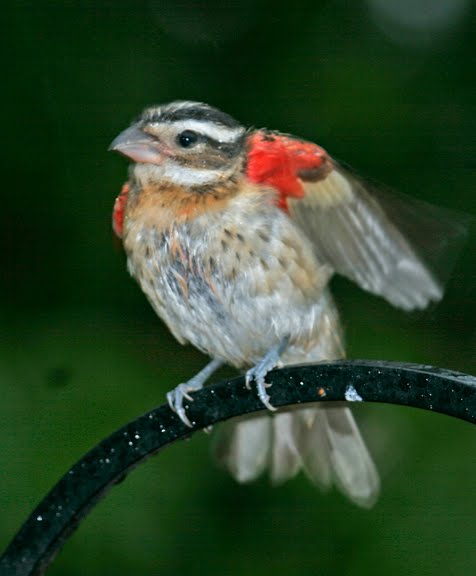
The first fledglings to show up were the Rose-breasted Grosbeaks - in a wide variety of plumages.  I counted adult 5 males at one point, and more than a dozen fledglings with their axillaries  (armpits) all shades of yellow, orange and red.


In just a week, the yard was full of "peeooow" begging calls and lots of fluttering.  The grosbeaks were soon joined by Baltimore Orioles, a lone fledgling cowbird, Red-bellied Woodpeckers, Downy Woodpeckers, Hairy Woodpeckers, Black-capped Chickadees and House Finches.  Together they created an early morning symphony of bird vocalizations right outside my kitchen window.


They've also created drama.

I've seen fledglings try their begging behavior on what appears to be one of their parents, on other fledglings and on species other than their own.


I've seen orioles eat suet, finches and woodpeckers taste the grape jelly and grosbeaks try to figure out the nectar and thistle feeders.

And I've seen them collide, fall off feeders and get up to give it another try.

One thing they're all starting to learn is the meaning of an alarm call.


It's mighty quiet after an accipiter takes one of the grosbeaks at my feeders.

Sunday, May 30, 2010

"blackbird singing in the dead of night"


I've had trouble getting a good night's sleep lately.  

Yah, there's the stress related to living in a time of economic uncertainty and environmental disaster (global warming, the Gulf oil spill).  And there's the bright light of a full moon.

But what's been robbing me of a good night's sleep the past couple of nights ... has feathers and a song.

With the uncharacteristic moderate temperatures and low humidity, I've been sleeping with my window open.   After finishing the final pages of Chuck Logan's Minnesota mystery, Vapor Trail Friday night, I was lulled to sleep by the comforting calls of the Great Horned Owl on the edge of the cornfield behind my house.  Who, who, who-whooo.

I was abruptly awakened at 2am by the loud and incessant repetition of the songs of a Rose-breasted Grosbeak, Blue Jay, oriole and kingfisher - right outside my window.

It wasn't a dream. 

A mockingbird?  No, their song phrases have 3 or 4 repetitions.

A Brown Thrasher? No,  they usually repeat their phrases twice.

My "black bird singing in the dead of night" sang his phrases only once. 

I got up, walked to the window and looked for the songster.  The noise was coming from a little shrub by the propane tank in my back yard.  Hmm.  I'll check it out when the sun comes up.

Then I forgot about it - until I was awakened again last night.

I went to bed around 11pm.  I could hear the call of the Great Horned Owl off in the distance, accompanied by a chorus of coyotes down by Misha Mokwa creek.  Bark, yip, yip, howl.

I was awakened from a sound sleep by loud bird chatter at 3am.  Deja vu.

I got up and went to the window.    The same monotonous phrases, this time strung together with a "meoww."

Whaddya know!  Mystery solved:  a Gray Catbird.

Saturday, May 29, 2010

Warbling Vireo

As I got out of my car at County Rd M and the Chippewa River Bike Trail, I heard one of the many bird sounds I could not identify.  It sounded like a vireo - but the riparian canopy was full of grosbeaks, orioles, tanagers and warblers.

It was way up there, singing away, driving me to distraction.

I'd left my iPod at home.  All I had with me was my ability to pish.  So I pished... and pished .... and pished.  Finally, the songster flew down for a look at what was causing all the sibilance.


A gray, non-descript bird slightly larger than a warbler, with a white eye-line leaned over to get a look at me.  Then seemingly satisfied that my pish was not worthy of concern, it flitted back into the shadows of the green canopy and resumed singing.


According to Cornell's Ornithology Lab, the Warbling Vireo is "a drab bird of riparian woodlands, more easily heard than seen. It has no distinctive fieldmarks, but its rapid warbling song with a accented, high-pitched last note is relatively easy to recognize."

It's a complicated rapid jumble of rising and falling notes, usually ending in an accented, higher-pitched note.

The mneumonics (memory assisting phrases) of the bird song goes like this:    "If I sees you; I will seize you; and I'll squeeze you till you squirt; brigadier; brigadier; briga-tee."

Yep, that makes it easier to remember.

Tuesday, May 25, 2010

Eastern Phoebe


I didn't notice the nest until I saw the drops of dark mud on the front steps.

Up until last year, an Eastern Phoebe had built an nest on the light by our kitchen door every summer for nearly a decade. 


While these flycatchers prefer "natural" nest locations, they've adapted to the human-built environment.   They look for locations (cliffs) often near water that are protected by overhangs - under bridges and buildings.

This nest is made of mud, green mosses and leaves - attached to the wall over the light fixture, under the eave.  The cup is lined with hair (cow?) and thin grasses.  The female builds the nest, lays from 3-8 eggs, incubates 16 days and feeds chicks for about 15 days.   She may double brood.  We'll see.

Tuesday, May 4, 2010

Spring Wildflowers and Neotropical Migrants

The thermometer hit 78º this afternoon.

Wildflowers are blooming.  Trees are leafing out.  Spring is bursting out all over the Lower Chippewa valley. 

T. flexipes Declining Trillium

Smilacina stellata  Starry False Solomon's Seal

 Trilliums and False Solomon Seal are in bloom.


Cliff Swallows have returned to the Durand riverfront Sunday.  They got right to it with rebuilding their mud nests.   Bank Swallows arrived yesterday.  Tree Swallows continue to battle with starlings and House Sparrows over nesting holes. 

Yellow Warbler

Yellow-rumped Warbler

Blue-gray Gnatcatchers arrived today - and along with them, the Yellow and Yellow-rumped Warblers. 
Chipping Sparrow

House Wren

The ubiquitous Chipping Sparrows and House Wrens are making noise and flashing their feathers - setting up their territory and building nests.