Showing posts with label bald eagles. Show all posts

Friday, January 7, 2011

The Best Place to See Bald Eagles: Alma, Wisconsin


Where's the best place to watch Bald Eagles on the Upper Mississippi River?

Last year, I would have said:  Read's Landing in Minnesota.  Sure, there are other places along the Mississippi River in Minnesota where you can get those iconic views of a dozen or more "eagles in a tree," but the highway overlooks between Lake City and Read's Landing are among the best.  Bring binoculars and dress for bone-chilling cold weather.

Ask me where to go this year, and I'll tell you:  The best place to see bald eagles is Alma, Wisconsin.

View from the indoor viewing area at Wings Over Alma (sans binoculars)

It's reliable:  you'll see dozens of eagles - flying, "surfing" (riding the ice flows), sitting like penguins on the ice and decorating the cottonwood trees along the river.

It's hassle-free:  you don't have to worry about pulling off the road, parking or traffic.

It's comfortable:  you're inside a heated building with great views of the eagle action on the river with an eagle "naturalist-guide-spotter" who provides the optical equipment and points them out to you.

And it's all free - no admission charge.  (They won't turn down a donation, if you want to make one.)

Where is this place?

Wings Over Alma Nature and Art Center - a little storefront at 118 North Main Street (in downtown Alma).

Before you head out the door, here's a few tips on where to look, when to go and how to behave....

Where to look:
Eagles go where the food is.   Bald Eagles feed on fish and carrion (dead animals).  
Look for them perched in trees near open water:  near power plants and the locks and dams along the Upper Mississippi River.
Look for them down-river from dams and “lock and dam” infrastructure where the fishing is easy.  Passage through dams is perilous for fish.  Many are killed and/or stunned, making the fish catching relatively effortless for eagles.
Look for them down river from power plants where cooling water is released back in to the river.  This warmer water – low in oxygen - causes fish kills.
Look for them strafing the surface of the water, grabbing fish and vulnerable (sick, starving or injured) waterfowl.
Our national symbol is not above feasting on dead animals.  Don’t be surprised to see them near roads – where they feed on roadkill – as big as deer, raccoons and as small as turtles and frogs.
Look for Golden Eagles back in the coulees and farm fields, where they hunt of the fly - rabbits, rodents and larger birds.    They’ll also feed on roadkill.  Last year, Buffalo County, Wisconsin had the highest concentration of Golden Eagles in the annual “Winter Golden Eagle Survey.”
If you want to go “eagle-watching,” but don’t want to deal with the cold and the traffic – head over to Wings Over Alma Nature and Art Center in Alma, Wisconsin.  You can watch eagles and waterfowl – up close – from the comfort of their indoor, heated birdwatching deck.   And they provide spotting scopes, binoculars and naturalists to show you where to look.  
Best Time:    
The best time to spot eagles this time of year is between 9am and 2pm.   
Etiquette:     
Winter is a very difficult time for all wildlife.    If you go out to look for eagles (and other wildlife), resist the temptation to get out of your car for a closer look.    Eagle inactivity is an important survival strategy when food is relatively scarce and weather is severe.  Seemingly benign human behaviors (walking too close, closing your car door, etc) can push an already stressed bird over the edge.   So…   
     1.  Stay in your car.  Don't approach eagles closer than a quarter mile. Avoid roosting areas.  
     2.  Don’t make noise to get a better photo: no honking horns, door slamming, radios playing, yelling, etc.     
     3.  Don’t let your dog out of the car.  Better yet, leave your dog at home.  
     4.  Bring binoculars or spotting scopes to get a better view.  
     5.  Be careful driving.  Don’t abruptly stop and pull off the road.   Watch where you are in relation to other vehicles.   
     6.  Don’t trespass.  Respect private property and avoid restricted areas.   
Be CAREFUL - and dress for the cold!

Monday, January 3, 2011

Hawks, Eagles and a Winter Red Fox

A roadside Red-tailed Hawk

After a weekend of snow and ice, the sun was shining and the sky was blue.  Despite the freezing temperatures (21- degrees F), I couldn't resist taking the Prius out to look for roadside raptors.  I didn't have to go far.  Rural Pepin and Buffalo Counties in west-central Wisconsin are full of hawks, shrikes and eagles.

A roadside Northern Shrike
Rough-legged Hawk


I was surprised to see so many Bald Eagles perched in trees along the farm roads - several miles from the frozen Chippewa River.

Bald Eagles at State Road 85 and Pepin County Road T

The sky turned gray around 2pm and it started to snow.  At the intersection of State Road 85 and County T, I asked my husband:  should we head home, or turn left on to Marsh Road?  I didn't wait for an answer.  I turned left.  I've never been on Marsh Road... maybe there actually is a marsh... maybe we'll see something out of the ordinary.

The road was icy.  I started to wonder if this was such a good idea after all.  But the Prius pulled us up the hill without a slip.

Then we saw something out of the ordinary.   I stopped the Prius; put it into park; and held my breath as I opened the window on the passenger side.  I pulled up my camera and snapped 2 photos of a red fox walking across the farm field, sniffing for rodents.


 It stopped and looked at us, then ambled off towards the tree line.


Red foxes are not uncommon in west-central Wisconsin.  Spotting them in the daytime is, however, a rare treat.   We sat in the comfort of the car - and watched, hoping to see this one pounce on a mouse or vole.  Not today.

This is the time of year when red foxes pair up and mate.  Their dens are almost always near some kind of water - a marsh, pond or stream.   Kits are born in March and April.  


A couple of years ago, I spotted a fox den and two kits, in a cornfield on State Road 25.

I was surprised to learn that red foxes are native to North America - and that they are the most widely distributed carnivore in the world.  Back in colonial times, the British imported red foxes to what is now the eastern United States - for sport hunting.

Populations of red fox increased as wolves were extirpated and continent was changed by human settlement.

Thursday, December 9, 2010

More Bald Eagles on the Upper Mississippi


It was a warm 12 degrees this morning when I drove across the Wabasha bridge.  I was surprised to see the Mississippi River is frozen over - totally.  I spotted several crows and only one Bald Eagle flying downriver towards the open water at Lock & Dam #4 in Alma.   That's where I'll be heading later today.


I can't believe how many Bald Eagles I've seen this week - and how close they were.  The viewing opportunities on the Wisconsin side of the river between Nelson and Buffalo City are the best I've seen in a decade - over 100 at Wings Over Alma, and 200 or more along the Buffalo City riverfront.


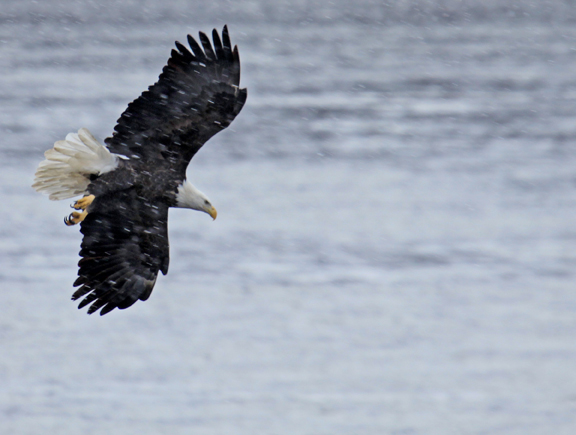
Here's a snapshot of  view across the river from the deck at the Wings Over Alma Nature and Art Center:  a raft of Common Goldeneyes and a handful of Bald Eagles perched in the trees and fishing.  The photo at the top of this blog entry was shot from the viewing deck in Alma.   All you need is patience - they have 3 spotting scopes set up indoors at the window. 


It's hard to believe Bald Eagles stick around when the thermometer drops below zero.  But they do.  I understand it's all about food... but the cold is brutal. 


If you go eagle-watching, resist the temptation to hop out of your car to get closer.  Disturbing winter birds is stressful for them, causing them to use up limited energy reserves.    Bald Eagles spend most of the winter conserving energy – by sitting in trees, soaking up the sun.  If you see one feeding on carrion near the road, slow down, but don’t stop and hop out of your car to snap that perfect photo.   When Bald Eagles are “disturbed” while feeding, they may fly off and observers have found they’re not likely to return.


Winter survival is all about conserving energy, the availability of food and thermoregulation. 

Friday, December 3, 2010

Bald Eagles on Ice - in Alma, Wisconsin


I drove down the Upper Mississippi River one last time before the snow storm hit today.  I wanted to see if - after more than a week of seasonably cold (freezing) weather - the Tundra Swans have moved on.

I didn't spot any - even though there were still a few spots on the main channel (and in the backwaters of Pool 4) that hadn't iced-over.  And I didn't hear any - no whistlings when I opened my car window (brr).   The swans are gone.

I did, however, hear crows and Bald Eagles - lots of them.  Nothing new about that.  In fact, it's an unusual day when I don't see at least on Bald Eagle from my kitchen window, and at least a half dozen on the drive in to town.

I expected to see a few of them along the river today, standing patiently on the ice around a fishing hole, waiting for a fish to cut the water's surface.

Big surprise:  I saw way more than a few Bald Eagles.  The final tally was over a hundred. 

Most of them were down by Lock & Dam #4 in downtown Alma.  They shared the river with a sky full of frenzied Ring-billed Gulls fishing down-river of the dam, where food is abundant, and easy to catch.  (Fish can get dinged in the churning water as they pass through the dam.)

Every day is a great day when I can get out and watch birds.  But today was special.

I've been watching birds along the River for more than a decade.  I've spent some cold winter days watching birds at the eagle "hot spots" along the Upper Mississippi River -  Colville Park in Red Wing, Reads Landing and Wabasha.   But I've never seen so many eagles on that 9-mile stretch of the river.

They were flying, loafing on the ice, hanging out in the cottonwoods along the river, scooping up fish, harassing other eagles to get them to drop their fish, chasing other eagles, soaring and chittering.


On the way home, I spotted a pair near Tell Lake (State Road 37 east), doing a little housekeeping - adding sticks to their huge nest, one of several in the Buffalo River floodplain.

If you go...

Stop the Wings Over Alma Nature and Art Center to warm up and watch eagles from their riverfront viewing windows.

Have lunch at Kate and Gracie's Restaurant and watch the eagles from one of their window-side booths.

Thursday, November 18, 2010

Eagles and Wildlife Art at the Mayo Clinic


My husband has had some health challenges recently, so we've been driving back and forth to the Mayo Clinic.  While he doesn't look forward to "going to the doctor," the hour-long ride to Rochester has a tranquilizing effect.  We watch for waterfowl and raptors as we drive across the Mississippi River, and as we drive up the bluffs and through the farmland.

Today it was "raptor alley" all the way.  Bald Eagles were everywhere, including a surprising number hanging out along the road between Kellogg, Plainview and Rochester.  Not just one or two, but groups of three and four - soaring and perched in trees at the edges of recently harvested cornfields.


We counted two dozen Bald Eagles, a half dozen Red-tailed Hawks and a lone American Kestrel.

If I had a choice about when to go to the Clinic - it would be spring and summer, when the Peregrine Falcons are nesting.   You can watch them on the falcon-cam at the subway level near the pharmacy.  It's like Discovery Channel meets "Brothers and Sisters."

Today I discovered there are more birds to watch at the Mayo Clinic - if you know where to look.

I had to park in the Graham Ramp because of construction across the street from the Gonda Building.  That took us on a new route through the Clinic's subway level.


That's when I saw the Orangutan, rhino and Bighorn Sheep.


Across the hallway, I spotted the Bald Eagle.

Who's the artist?

To find out, I had to read the text to the right of the bird.  "I never met an animal I didn't like," was the quote attributed to the artist.

The famous artist was born in Pittsburgh, son of Czech immigrants.   In these 10 screen prints depicting endangered species, he used his signature brilliant colors, photographic blow-ups and dramatic lines to create almost human-like expressions. 

Recognize him?

The Pop art icon:  Andy Warhol.

If you're interested in art, be sure to stop at the information desk in the Gonda Building (Lobby Level) and ask for a self-guided art tour map.

Tuesday, March 23, 2010

Lake City Eagles, Gulls and Ducks

I crossed the Mississippi River to look for migrating birds this afternoon.  I found them in Lake City.

 Riverfront Park at Reads Landing, MN - looking south on the flooded Upper Mississippi River
I stopped along the way at all the usual places.  We didn't see many birds at Reads Landing -  only a flock of Cedar Waxwings feasting on the insects swarming in the cottonwoods.  No ice.  No eagles.  No waterfowl. 

Further up Highway 61, the Mississippi was still covered with a very thin sheet of gray ice.  I couldn't resist stopping to look for eagles. 

 A tourist looking north at eagles on the ice on the Upper Mississippi River north of Reads Landing


First stop: the Lake Pepin sign.  Looking north, we spotted rows of eagles sitting on the ice, loafing and fishing from the holes left by ice-fishermen.

Camp Lacupolis:  my first of the season pair of Common Mergansers.  The minute I spotted them, they dove, and bobbed back to the surface too far away to photograph.


Lake City Sportsman's Club:  Herring Gulls and a lone Ring-billed.

 Ring-billed Gull in Breeding Plumage


The jetty at Lake City Marina:  Dozens of Bald Eagles and gulls on the ice flows.  Worth the walk down to the light.


A pair of Lesser Scaup at Lake City's Ohuta Park

Ohuta Park (Park and Chestnut Streets):  A Bald Eagle (a sad story), tangled up in fishing line - clearly starving, but still flying short distances - I contacted the National Eagle Center;  and a raft of waterfowl (Red-headed ducks, Lesser Scaup and American Coots).

Before we headed home, we stopped to see what's up at Colvill Park in Redwing.   It was flooded!

No eagles.  No waterfowl.   Just a lot of very fast moving water.

A sign at the exit says the park will be closed Wednesday.   Flood waters will crest later this week.


Friday, February 19, 2010

Golden Eagles in Buffalo County WI

Last month, 60 Golden Eagles were spotted in Buffalo County during the 6th annual winter Golden Eagle count.  With the uncertainty of icy rural roads, snow and my Prius brakes, I'd been reluctant to go look for them.  Today I had great weather and no excuses.  I hopped in the Prius and headed over to State Road 88, near Gilmantown to look for Goldens.


The Coulees were full of Bald Eagles, perched in naked deciduous trees at the edge of farm fields.   We spotted several flocks of juncos, horned larks, tree sparrows and crows apparently feeding on weed seeds recently uncovered along the roadsides by the county snow plows.  Wild Turkeys foraged in the cornfields full of stunted stalks left unharvested after last summer's drought.

But despite my stealth Prius, the birds took off before I could open the car window. 

We spotted lots of raptors in Praag Valley between Gilmantown and Czechville.

 
Red-tailed Hawks.  


A dark-morph Rough-legged Hawk tipping his tail then lightening his load (note the white mute) before take-off.

But no Golden Eagles.

Our consolation prize?  Five Ring-necked Pheasants, close-to-the-road.

Tuesday, February 16, 2010

Bald Eagles @ Reads Landing

Can you spot the three Bald Eagles roosting in trees, one on the ice, 
looking west towards the Wisconsin bluffs along the Upper Mississippi River
in Reads Landing, Minnesota

It was a warm and sunny 34º today.  Warm enough to melt the ice on the highways, and sunny enough to make me drop everything and hop into my Prius.   I headed over to Reads Landing to look for the Trumpeter Swans.  They were gone.

But the eagles were still around, growing in numbers.  Flying up and down the river, floating on thermals along the bluffs, fishing and "stealing" fish from others, loafing and perching.

They're here because the river is open, and the fishing (gizzard shad) is good.

If you've got a couple of hours between 10 am and 3pm, now's the time to head to Reads Landing to enjoy the show.


Wednesday, February 10, 2010

Bald Eagles @Lake Pepin, Reads Landing and Colvill Park

Bald Eagle north of Reads Landing, Minnesota

After two days of howling wind and snow squalls, I welcomed today's blue sky and sunshine.

I headed up the road to the Maxville Alternative High School to check out the deer carcass strung up in their yard.  The chickadees and Downy Woodpeckers were still working on it.  Juncos shared the thistle feeder with the goldfinches, and the little Red-breasted Nuthatch "owned" the peanut suet feeder.

After an hour of bird whispering and watching, I headed home for lunch.  Driving out of the school parking lot, I looked to the left and spotted a Bald Eagle a dozen yards away - flying west, parallel to my car.  I looked at her, thinking - can I pull over and get my camera focused fast enough?  Not a chance.

As she flew, she turned her head and looked me, looking at her.  It was as if she was challenging me to a race.  Then I thought, okay... forget the camera, I'll clock you.  She flew about half a mile, before cutting in front of me and heading north to the Chippewa River Bottoms.  My Prius computer had her going an effortless 35 mph.

As I pulled into my driveway minutes later, I knew what I'd be doing the rest of the day:  eagle-watching.

Nothing at the Wabasha waterfront, but there were plenty of Bald Eagles at Reads Landing.  And the    Trumpeter Swans hadn't left.  A dozen were feeding in the bottoms.


Eagles and Trumpeter Swans at Reads Landing

I hit the jackpot at the overlook between Reads Landing and Camp Lacupolis.  There were lots of eagles - fishing, flying and perched - all along the open channel.

The last stop was Colvill Park on the south side of Red Wing, MN.  I was surprised to see the River channel open - and the cooling lagoon by the power plant (where, in the past, I've seen trees literally full of roosting raptors) frozen over.  Nothing happening there.

I crossed the Mississippi at Red Wing, and drove home on the Wisconsin side at sunset.

 Looking south at the Wisconsin bluffs and ice houses 
on the Upper Mississippi River north of Lake Pepin

Friday, January 29, 2010

Eagles & Trumpeter Swans on the Upper Mississippi


It was seasonably cold today - by noon the temperature was sunny 16ºF.   A great day to go check out the eagles down the road along the Mississippi River.

Tom and I hopped into the Toyota Prius and headed west, then north from Wabasha towards Lake City.  We hit the jackpot at our first stop:  Reads Landing.


Reads Landing is one of the best places in Minnesota to spot bald eagles this time of year.  The flow of water from the Lower Chippewa River and Lake Pepin speeds up as it moves through the narrow channel, keeping the river from freezing from Reads Landing to Wabasha.   Eagles are attracted to places like this - where the river is open and the fishing is good.


We counted over 200 eagles on the ice on both sides of the river...

loafing in trees over-looking the river...
and flying overhead...

... along with goldeneyes, mallards, crows and - I couldn't believe my eyes (I had to roll down my car window and hear their calls) - 2 dozen Trumpeter Swans.

The Trumpeter Swans were a first for me this time of year.

Reads Landing, however, isn't the only place to spot eagles in our neighborhood.  

You can see dozens hanging out in Red Wing's Colvill Park (where the river is heated Xcel Energy Plant).  Look for them in Alma, Wisconsin by the lock and dam.  Arcadia, Wisconsin, home of Ashley Furniture and Gold'n Plump Chicken, is another great place to see Bald Eagles.   Call the Chamber for sighting info before you go... (608) 323-2319.

And in case you didn't know... Buffalo County Wisconsin is a "hot spot" for wintering Golden Eagles.  Sixty Golden Eagles were spotted in the bluffs of Buffalo County on the 6th annual golden eagle survey, Jan 16th! 


Friday, January 15, 2010

Winter Eagle Watching Tips


Winter is a challenging time for wildlife.  They have only three things on their minds:  watching out for predators, finding food and burning up as little energy as possible.
While some might describe them as lazy scavengers, I prefer to call them opportunists.  Their feeding strategy is all about conserving energy.  

They often rely on other birds – crows, ravens and vultures - to lead them to carrion, food that’s already dead.  They take sick and injured waterfowl.  They pirate food from other animals, a practice known as kleptoparasitism.  And if they’ve got the energy, they’ll actually catch live prey.
This time of year, eagles are most active at dawn (7-10am) and dusk (3-5pm).  Depending on location and the weather, you may see them flying to and from shared night roosts, and fishing or feeding in large numbers.  

When it’s snowing with sub-zero wind chill, eagles usually don’t leave their roosts.  

Know Your Eagles

Just about everyone knows what an adult Bald Eagle looks like - the huge brownish-black birds with white heads and tails.  But what are those other big black birds that hang out with them? 


They’re likely Bald Eagles too, the immatures.  They have dark beaks and dark feathers, mottled with white.  It takes about 4-5 years for Bald Eagles to get their distinctive white head and tail feathers.  There’s also a size difference.  Females are about 25% bigger than males.


From a distance, you might confuse them with other large soaring birds.  Take a look at the winter range and distinguishing characteristics of Golden Eagles, Osprey, Black Vultures and Turkey Vultures.  None of them however, sounds anything like a Bald Eagle with its surprisingly wimpy call – a high, thin “chitter.” 

Planning Your Trip  

Here are some practical suggestions for a successful eagle-watching expedition: 
  1.       Dress for the weather – in layers (gloves, hats, scarves, boots and a windbreaker) 
  2.       Keep your distance.  Use binoculars and a spotting scope.  If you don’t have any, don’t be shy.   Most bird-watchers are happy let you take a look through  theirs. 
  3.       Stay out of sight (in your car or building). 
  4.       Be quiet.  Don’t yell, honk your horn, or slam your car door. 
  5.       Don’t bring your dog. 
  6.       Respect private and restricted property.  Don’t trespass. 
  7.       Bring a camera.  You’ll need a telephoto lens (400-600 mm) and tripod for great photos.  If you have a point and shoot digital camera, consider a digi-scope adapter. 
  8.      You’re likely to see ducks and other birds, so bring a bird ID book. 
  9.      Bring along a thermos of your favorite hot beverage. 
10.      Be careful driving!  Keep your eyes on the road and use designated pull-offs only.

Resist the temptation to get close, or try to make roosting eagles fly.  That’s harassment, and it’s a federal offense with stiff penalties.

It’s also illegal to collect feathers.  While they’re no longer considered endangered, Bald Eagles are still protected by federal laws - the Bald and Golden Eagle Protection Act and the Migratory Bird Treaty Act.

Thursday, January 14, 2010

Bald Eagles: Now's the Time to Spot Them

Back when I was a kid growing up in New Jersey, if you wanted to see Bald Eagles in the wild, you had to pack your binoculars and head up to Alaska.  The only eagles we were likely to see were in a cage at the Bronx Zoo.

With barely 400 breeding pairs in the lower 48 states, our national bird was on the verge of extinction.  The situation looked bleak for the Bald Eagle when it was placed on the federal endangered species list in 1973.

Over the past 40 years, Bald Eagles have made a spectacular comeback, now with more than 60 nesting pairs in the Garden State alone.   Most are in the Delaware Bay counties of Cumberland and Salem, but eagles can be spotted throughout the state.  The number of wintering eagles along Delaware River has increased dramatically from fewer than 10 in 1978, to a record high of more than 250 in 2008.

While I don’t live in New Jersey any more, it’s a rare day that I don’t see at least one Bald Eagle flying overhead in my new neighborhood, along the lower Chippewa River in Wisconsin.  In the winter, there are so many eagles that I have to be careful that I don’t hit one along the highway.  (Our national bird is not above picking at road kill.)

Even though eagles are common here, I just have to stop to watch and marvel whenever I see one.
  
But you don't have to live in Alaska or the upper mid-west to see Bald Eagles.  No matter where you live, the chances of spotting a Bald Eagle in the continental United States during the winter are very good - if you know where to look. 

You’ll find them where food - fish - is plentiful.  When the lakes in their northern breeding grounds freeze over, eagles migrate to rivers, lakes and seacoasts where there’s open water, good fishing and protected roosting sites.

If you’ve never been eagle-watching before, now’s the time get started.  January through March, Bald Eagles can be spotted in just about every state.  You can go on your own, take a guided tour and attend an eagle-watching festival.  

Wednesday, January 13, 2010

Winter Bald Eagles and Wild Turkeys


With the temperature hovering around 32F, today was the beginning of a good old mid-western winter heat wave - and a great day for taking the Prius for a spin.

Would my favorite rural rustic road be clear enough for a Prius - with no snow tires?

Why yes, it was.  And the roadside was full of birds.

The first was a Bald Eagle, taking a mid-day rest in a tree by Tarrant Park in Durand.   Look in the trees along the Lower Chippewa - where the river is open - and in the sky overhead.  You'll see lots of them.  We counted a half dozen on the way to Eau Claire, adults and immatures.

adult Bald Eagle - immature Bald Eagle

We spotted several Red-tailed Hawks in Meridean, hanging out in their usual roosts - at the top of deciduous trees along the edges of the corn fields;  American Robins bathing in the melting snow in the sloughs; and  Tree Sparrows and juncos drinking and bathing in roadside puddles.

Then, just south of Eau Claire, we spotted 2 dozen Wild Turkeys close to the road - in a farmer's front yard.  They are so very smart.  The minute I pulled off the road, they started to disburse.


I had to laugh at the Frosty the Snowman sign by the farmhouse - waving at the gobblers.  Too funny.

It's also amazing - to think Wild Turkeys were extirpated from Wisconsin back in 1881.  Farming and logging resulted in destruction of the habitat these birds prefer - oak forests.  It wasn't until nearly 100 years later that the Wisconsin DNR embarked on a program to bring them back.  It began with a trade: Ruffed Grouse for Wild Turkeys.

The rest, as they say, is history.  The 29 Wild Turkeys (from the Missouri Department of Conservation) released in Vernon County 30 years ago, have multiplied to the now more than 300,000 gobblers in the Badger state.  A wildlife conservation story with a very happy ending.